One of our favorite types of design projects here at Kimball Starr Interior Design is lofts. It’s exciting to have so much open area to work with: high ceilings, often lots of natural light, and few walls or physical restrictions. However, sometimes you need boundaries to help define an open floor plan, to give it purpose and make it more cozy and livable. Over the next series of blog posts about loft design, we’ll show examples of how to get maximum design impact and best use of your open plan loft based on a recently designed San Francisco loft interior by Kimball Starr.
When you have high-ceiling lofts with lots of open floor space to work with, one problem can be how to design the interior appropriately so they feel intimate. Custom rugs, draperies, and decorative accents are essential design elements that soften the acoustics and personalize the loft to feel more like your home.
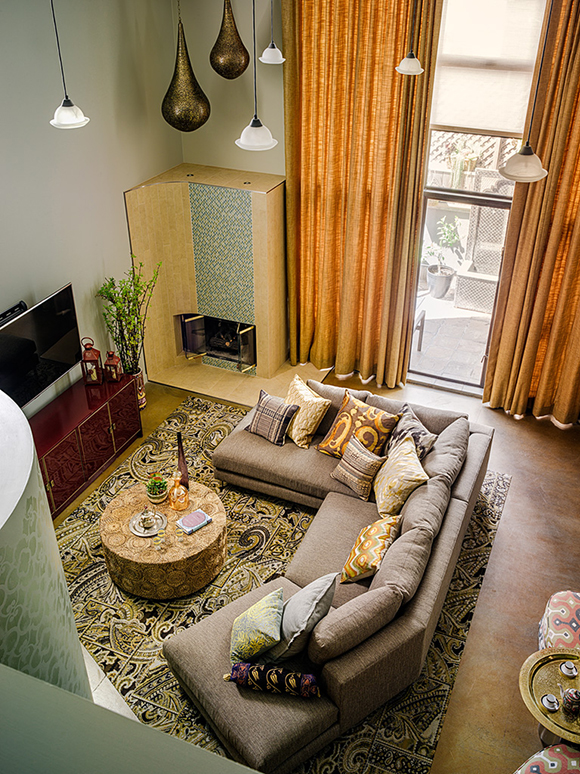
In this beautiful award winning San Francisco loft interior, multiple techniques have been used simultaneously to both accentuate the room height for visual drama, and to lower the ceiling height to create intimate entertaining areas.
Kimball Starr Interior Design / photo by Joe Fletcher
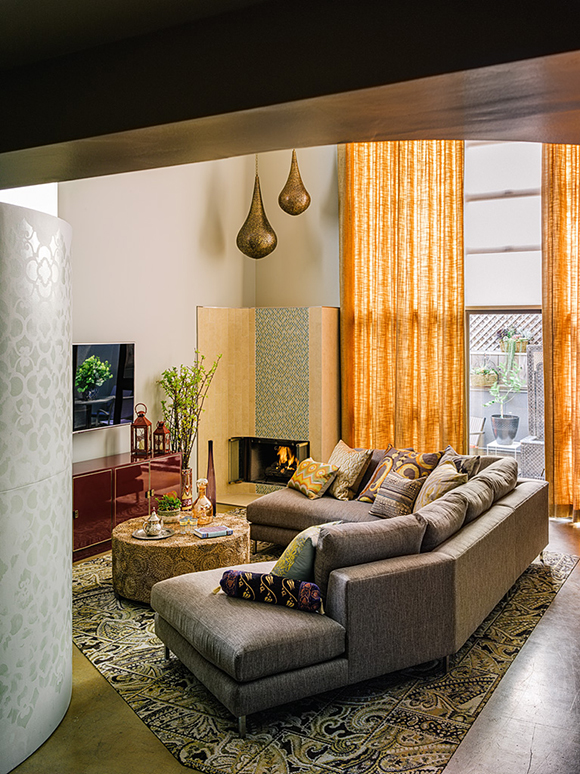
Authentic Moroccan brass teardrop pendants fill the high space above the custom-designed curved fireplace and dramatic 18 foot high golden draperies emphasize the room height and capture sunlight with a backlit glow. Hanging hand-pierced brass pendants down to the top of the fireplace lowers the visual focus and adds a stunning design element.
To create a more intimate space in the living area, white glass pendants hang down to visually lower the ceiling directly over the seating area and the living room rug has been custom-cut at an angle to echo the lines of the sofa creating room for the adjacent pivoting bookcase on floor casters. By customizing the shape and size of the rug, we’ve defined the living area zone and created an inviting and intimate space.
Kimball Starr Interior Design / photo by Joe Fletcher
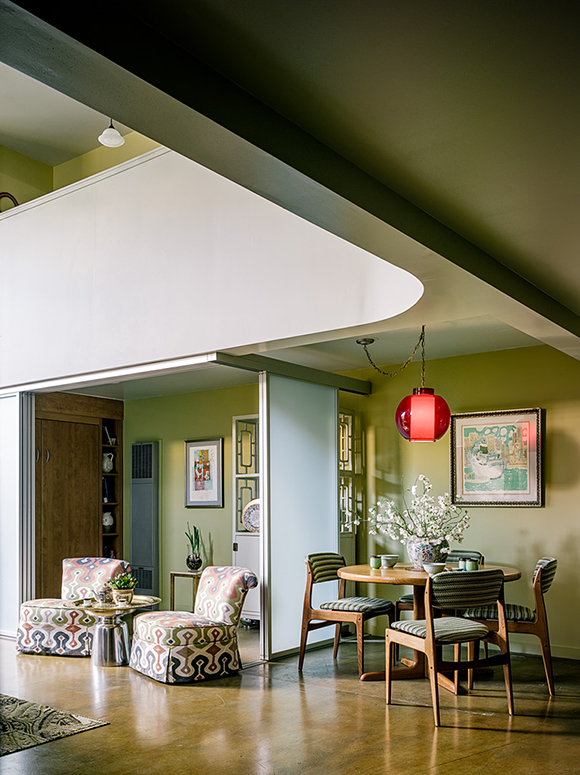
When entering the loft, you stand underneath the upstairs loft overlook where this lower ceiling compresses the space and identifies the entry and kitchen as separate zones, showing how varying ceiling heights in the open floor plan can create different spaces. After walking past the lower ceiling, the compressed space explodes into soaring ceilings, underscored by the dramatic height of the draperies.
In this incredible space, it’s important to create a feeling of intimacy for relaxing and entertaining, which is accomplished by the comfortable contemporary sofa sectional offering multiple seats for reading and entertaining next to a roaring fire.
Kimball Starr Interior Design / photo by Joe Fletcher
An intimate mid-century dining area and separate lounge area are created by grouping furniture under the lower ceiling. The entire space where the lounge chairs are located, converts into a guest bedroom which we’ll show you in the last of this 3-part series of Loft Design. It’s easy to see how you would live in these spaces – they feel cozy and intimate.
Filling spaces often isn’t a problem for modern homeowners- it’s more about making lofts feel comfortable and cozy while still preserving their dramatic openness. The best loft design is a balancing act, and we’re loft design experts at Kimball Starr Interior Design! In the next installment in this 3-part series on loft design, we’ll talk about clever ideas for loft storage. Please check back next Wednesday to learn about storage solutions for this loft or yours.
Kimball Starr Interior Design is a San Francisco award winning loft design firm that provides contemporary interior design for residential and commercial interiors.
San Francisco interior designer, Kimball Starr, is featured as the interior design expert in a guest appearance on the nationally televised series of PBS “Creative Living with Sheryl Borden”. In this 3-part segment, the San Francisco interior designer teaches how to mix patterns, color, and texture to enrich the look of your home interior.
In this third video segment, Kimball shares expert tips on how to mix fabric patterns in a contemporary bedroom. She creates a romantic space and balances the masculine and feminine styles of a married couple through a curated selection of materials, fabric patterns, texture, and color.
In case you missed the first two videos about how to Style Your Home with Pattern, Color, and Texture!, here are Video 1 and Video 2.
Video transcript below:
♪[music]♪
[Announcer] – With your host Sheryl Borden.
– [Kimball] So now we have a dini- a bedroom area, I should say.
– [Sheryl] Bedroom, okay.
– So this was a newlywed couple and they’re very young and they wanted something really fun and youthful.
– Uh huh.
– So, we still wanted to keep it romantic but not too feminine that, as you were saying,
– Right
– the husband feels alienated and feels like he’s living in girly-land.
– [laughs]
– So we started with this rug that has a really geometric print so it’s a little bit of a masculine feel but popped it with some fun color. And I– on this I have a grass cloth. Let me show you the other. So that’s our bed. And this is to the right of the bed. And you can see there’s a grass cloth here.
– Oh, on the wall. Uh-huh.
– If you were feeling a little adventurous you could do something like this and really add a lot of pattern and texture.
– This, this is the grass cloth.
– This is, this is the– yeah. This is—
– It’s so, so much like the– I can’t believe it. – [laughs]
– How you found that!
– It’s not the same manufacturer.
– Uh huh. – Yeah.
– That’s amazing.
– And so the drapes were done in this fabric and this is a blackout drape so it doesn’t let any light through and because it was so dark I really wanted to bring a splash of color and some brightness into—
– Yeah.
– the room. So by using this—
– a border or—
– Mm hmm, by using this really fun—
– an accent.
– accent, this yellow accent, and our side tables are done in a lacquer and we actually had them custom painted in this really bright yellow on the sides of the bed and then our lamps that we purchased were just simple white lampshades but you can take any sort of fabric and cover. And so this is the floral fabric that we took to cover the lampshades that sit on top of the nightstand.
And then that leaves us with our wall color. So, I picked kind of this mauve-y tone and then for the ceiling we just lightened it up a little. And then all that’s left– Oh, there’s also some sitting chairs to the right of that, which are white leather.
– Oh, okay.
– And all that’s left is the bed. So we have a headboard, which we used a really luxurious kind of sexy velvet, which is great for honeymooners and newlyweds. And here I have a floral print for the bed spread but if your going use this sort of grasscloth for the space I think that would just start to be too much—
– Too much.
– pattern. So assuming you use something like that, then you tone it down and use a solid color like this, really thin wool, and then you can accent with pillows. And you can do some little small—
– That’s what really pulls things together– – Yeah.
– It seems like, when you do the accent pillows.
– Absolutely, and then this pulls in the colors. It’s a fun little pattern and if you wanna do something a little bolder you can use something like this also as a
– Yeah, that’s pretty with it too.
– accent for the pillows on the bed and the white brings in the white leather chairs and most of the white of the lamp shade so you have a balance of light,
medium, and dark tones.
– And that’s important too.
– Yeah and then if you want to really make it kinda more moody, then you could also bring in something like this, which is a darker accent pillow.
– But if you want—
– Oh, for the pillow.
– Mm hmm – Uh huh
– Yeah.
– Oh I love the colors you work with. What do you do when someone wants colors you don’t like? Is that hard to work with?
– You know what? There’s no colors I don’t like.
– Oh okay. – So— [laughing]
– So that never happens.
– Well it’s a good thing. Well, you do a wonderful job. I’ve enjoyed seeing—
– Thank you.
– what all you pulled and put together.
– Thank you so much.
– Thank you so much Sheryl, it was fun.
Kimball Starr is a San Francisco award winning interior design firm whose residential interiors have been featured on national television and globally published in a series of hardcover books. Diverse spaces spanning contemporary design to traditional interiors show the variety of styles provided by this San Francisco interior designer.
In this nationally televised series of PBS “Creative Living”, Kimball Starr is featured as the interior design expert in this 3-part segment where the San Francisco interior designer teaches how to mix patterns, color, and texture to liven up your home interior.
In this second video, Kimball shares how to mix fabric patterns in a traditional living and dining room by using outdoor nature as the color inspiration. The San Francisco interior decorator mixes mahogany dining chairs upholstered in traditional silk pattern, and adds a burlap tablecloth for an unexpected twist with casual elegance. The traditional living room mixes leather, velvet, and linens for a timeless look.
In case you missed the first video about how to Style Your Home with Pattern, Color, and Texture!, here is Video 1.
– [Kimball] So I have some more examples here, and this is a living area, which it’s a more traditional feel.
– [Sheryl] Uh huh.
– And some of these examples up for you. So I like to start with the rug first.
– Oh.
– Because that really…
– The bottom.
– Sets, sets the foundation. Thank you. So here our main colors are dark reds, rust colors, and greens. And the underlying concept or theme for this space was a botanical feel.
– Oh ok.
– So the homeowner really likes leaves and flowers and that outdoor nature feel.
– And he has skylights.
– It brings it inside.
– That’s right and you also want to think about the, the actual light. So in this space there’s a lot of natural light.
-A lot of light.
– So you don’t want to really, want to do heavy dark colors cause it feels counter-intuitive to the natural architecture of the space.
– Oh okay.
– So we’d like to treat…keep things light, but still add a little punch of color here and there. So we have next to them, here’s some close-up shots. So here’s the dining area, to the right.
– Uh huh.
– And I’m going to show you a little more close-up of that.
– Oh, uh huh.
– So you can see, so we have our–
– It’s the chair cushion.
– Beautiful dining chair fabric and now there’s no draperies in this particular situation because the homeowner really loved the view and didn’t want to cover anything; but if you wanted to do something you could use something like a really thin linen sheer that has a really subtle…
– And it’s got that botanical look, it’s got the leaves.
– That’s right.
– You’ll be carrying that out.
– And when the sun shines through this, it’s really going to wash it out so it’s going to be a subtle, floaty color.
– Mmmm
– And the wall color that’s there on the window…
– Oh how gorgeous.
– Is this color right there, so you could do that or if you’re not really a ‘sheer’ person you could use something like a woven grass shade notice the nice texture it gives.
-Uh huh.
– Again it gives, again it really adds a beautiful natural outdoorsy feel.
– And sometimes it nice to use this, I would think and so something doesn’t become so feminine.
-Yes.
– If there’s a couple living there you want to bring in some elements so that he sorts of feels like he suppose to be there…[laugh].
-That’s right, that’s right you’re not gonna make it all pink…[laugh].
– Right…[laugh].
– So, then we have our table that I put with the burlap covering because it’s mahogany and I felt with all that dark mahogany that the chairs and the dining table was a little too heavy for the space.
– Lightened it up, uh huh.
– Right cause we had talked about how it was a lighter space and then moving over to our sofa… We have a close-up of the sofa area.
– Oh is that a leather or….
– Yeah.
– …Suede or something.
– So the sofa is actually wrapped in leather.
– Umm.
-And then there’s…
– Oh it’s got the green I just now see the cushions, uh huh.
-Yeah and then the actual cushions here.
– Uh huh.
– It’s done in a linen velvet and a linen velvet is a really durable fabric. It’s gonna wear…
– Wears well.
-Yes and it still has a really elegant feel to it.
– Uh huh, all these colors are just looking wonderful together.
– Oh thanks. Green is my favorite color.
– Well I kinda like it too [laugh] so you’re starting with the floor and you’re building up from there.
– That’s right.
-Uh huh.
– So we have this color and then the color behind on the wall there is here, so we have this soft green with a creme color and then we have the sofa with the leather. And then we have our drapery with our…
– Uh huh.
– …Dining chair fabric, the burlap and then now all that’s left is to add some fun accents.
-Oh.
– And we also have our swivel chair here, which is–
– Oh there it is.
– Right here.
– Uh huh.
– This kinda of tan color and I like to bring in again we have kinda more light airy feel with botanicals and it’s a linen.
– Now what would you use these for?
– These you could do for your throw pillows.
-Oh okay I was thinking, how is this going… I see now.
– Yeah, so this would accent on top of the swivel chair. These would be your throw pillows and then for your sofa, because it’s a bigger, bulkier sofa, you can afford to do fabric that feels a little heavier. And you can either choose to go more in this tone for an accent which picks up the red…
-Uh huh, I like that one.
– Or there is a little bit of blue in there or you could even do both.
– Yeah, it really pulls the blue out. I didn’t see any blue in there, but I do…
– Yeah, it’s really subtle…
– Now that you put that with it, uh huh.
– And if you like little tassels and fringe this could go on the burlap tablecloth.
– Which it also softens that up a little bit.
– It does it adds a little interest to in movement instead of it just being a sharp edge.
– And then for one last item in the space, something most people don’t think about for texture, which is not necessarily a fabric, is using plants.
– Oh yeah, uh huh. I just think that every room almost needs a plant.
– Yeah.
– It just, it just maybe it is because it brings the outdoors in.
-Yeah it really does.
– It just looks nice.
– And they’re wall mounted and you never have to take it off and they just grow right on the wall.
– I see, very good.
– So then we have, so that’s our living area.
Kimball Starr is a San Francisco award winning interior design firm whose residential interiors have been featured on national television and globally published in a series of hardcover books. Diverse spaces spanning contemporary to traditional interiors are indicative of the variety of styles provided by this San Francisco interior designer.
Confused on how to mix fabric patterns in your home? Not sure when to use natural materials vs. synthetic materials? In this nationally televised series of PBS “Creative Living with Sheryl Borden”, Kimball Starr is featured as the interior design expert in this 3-part segment where the San Francisco interior designer teaches how to mix patterns, color, and texture to liven up your home interior.
In this first segment, Kimball teaches how to mix fabric patterns in a contemporary San Francisco dining room. By mixing different upholstery fabrics on the dining chairs, the interior décor can be either formal or casual, and either colorful or subdued.
Here are Video 2 and Video 3 of this 3-part televised segment on How to Style Your Home With Pattern, Color and Texture!
Video transcript below:
♪[music]♪
– [Announcer] With your host Sheryl Borden.
– [Sheryl] Kimball, thank you so much for being with us today. I know when I have quilters on they’ll always say– the question they always get asked the most is, how do they combine textures and colors and stripes and patterns and everything in a quilt? And I guess you work with a lot of same situations when you’re doing interior designing, don’t you?
– [Kimball] Absolutely. It’s just in a bigger space.
– Uh huh. And probably a bit more expensive, too.
– Yes.
– So, you wanna think this all out ahead of time. So, how do you go about it? How do you work with someone?
– Well, the first thing, I think it’s important to have some sort of underlying theme or concept for your space; whether it’s a botanical theme, or you want a really romantic, rich color kind of mood, just so that everything that you pick ties together. And then you should think about the activities you’re doing in the space; are you gonna be watching football, are the dogs going to be running all over the furniture, are kids gonna be throwing up on it. [laughs]
– You know, everything.
– Right. So then you need really hard-wearing fabrics. Or you would like to entertain and have really fine fabrics and really fancy cocktail parties, then you could use something like silks.
– I see. Okay. So, those are all questions you would ask the homeowner, or they would tell you when they’re ready to decide.
– That’s right. And in general, for me, I like… linens are great. They can be used in a relaxed environment, and they can also be dressed up for a formal environment.
– Oh… So some work multiple tasks.
– Absolutely. Velvets are beautiful for their very classic look to them. And if you do need things that are really hard-wearing then that would be synthetics, polyester or something like an ultrasuede, which is a polyester. And then for a lot of sun exposure, solution-dyed acrylics are excellent for outdoor fabrics.
– Oh, yeah. ‘Cause you don’t want something that’s gonna fade in the first 30 minutes it’s out there.
– That’s right. And silks are beautiful but they are very delicate. And if they’re exposed to direct sunlight they will rot and will start to disintegrate.
– Yes, just like with clothing.
– That’s right, that’s right. So, here I have a dining room where I use multiple colors for the chairs. And this is just to show–
– It’s kind of fun.
– Yeah, it is. And it’s just to show you don’t have to do everything the same color, and it’s okay. With the rug, what we have a brown, a chocolate brown with a light blue stripe, and then teals and blues, and then a pattern. So, just to kind of show you that example, I brought some fun colors, and this is very fun to look at. So, here we have a stripe with a teal color and a brown. And we have more of a curvilinear pattern, and then a solid. So, this is something with a dining area, you could mix these three. And the reason that these work is if you look at the ground color here, the background color, which is kind of a taupe-y brown, it’s the same color in here. So, that’s why these colors–
– They work.
– That’s right. And the patterns work together.
– So, you repeat a portion of it?
– If you find fabrics that have a common color, that’s very helpful. And they’re the same scale. They feel like they’re about the same proportion in the size.
– One’s not a big floral or something and then a tiny little print.
– That’s right. And that can work in a room; like if you have a pillow, and then you have the sofa for the large-scale pattern and the small scale pattern. But because in this case dining chairs that are right next to each other, and it’s the same piece of furniture, I like to keep them similar scale.
– I see. That makes sense.
– So, you could do this, you could do it like have two chairs like this, you could have your head of your chairs and the side chairs of this color. And then here is just one other example illustrating the same thing. This is a really– There’s so many amazing, there’s so many amazing fabrics that are coming out now, this cut velvet and viscose. And if you want– If this is little flashy for you, you could just do this for your arm chairs at the head of the table, and then you could accent it with–
– More subtle.
– A really beautiful beige linen.
– Oh, I love those.
– And it’ll be very elegant. Now, if you’re somebody like me who likes a lot of color…
– I like it too. That’s beautiful.
– You can do your side chairs in something like this beautiful green velvet. And you can even mix. Or if you’re not a fan of color then you can just do two colors in that.
– Oh… These are gorgeous.
– Aren’t they?
– So, you’re repeating colors that’s, and that’s sort of what they talk about in quilting too. It works if you repeat some of those.
– Yeah.
Kimball Starr is a San Francisco award winning interior design firm whose residential interiors have been featured on national television and globally published in a series of hardcover books. Diverse spaces spanning contemporary design to traditional interiors show the variety of design style provided by this San Francisco interior designer.
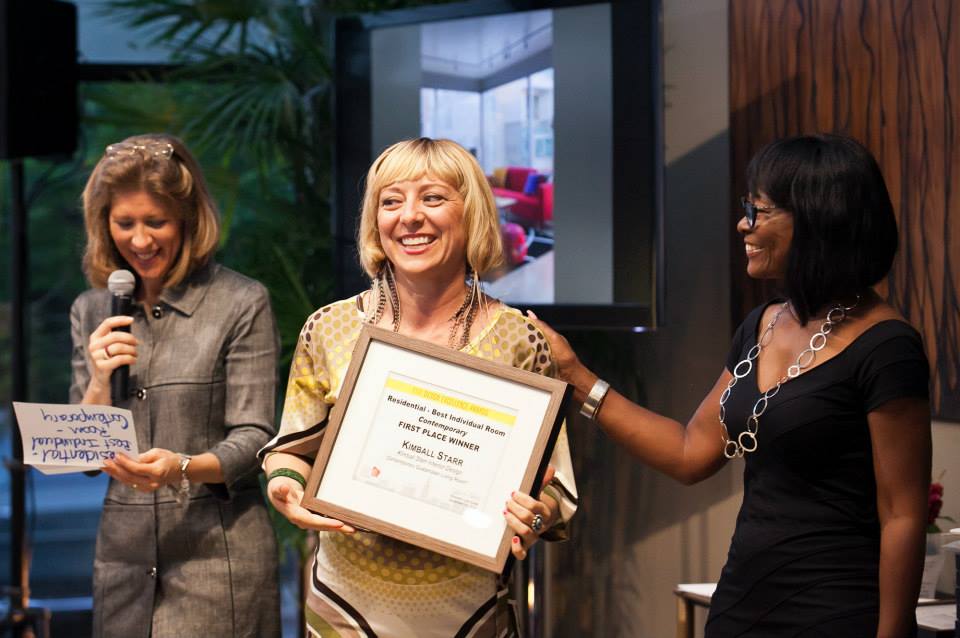
Two winning projects by Kimball Starr Interior Design were honored with Design Excellence Awards at a ceremony held in San Francisco, California on September 18, 2014.
MC Angela Merola, Kimball Starr and ASID President-Elect Norma Ryles at the Design Excellence Awards Sept 18, 2014. Photo by TiagoRussoPhotos.com
The awards, produced by the American Society of Interior Designers California (ASID) North chapter and hosted by NIDO living contemporary furniture showroom, reflect the highest standards of design excellence for interiors in 21 categories spanning commercial, residential and product design. Kimball Starr defeated competitors in each category to win First Place for “Residential: Best Individual Room – Contemporary” and Second Place for “Residential: Modest Budget, Big Impact”.
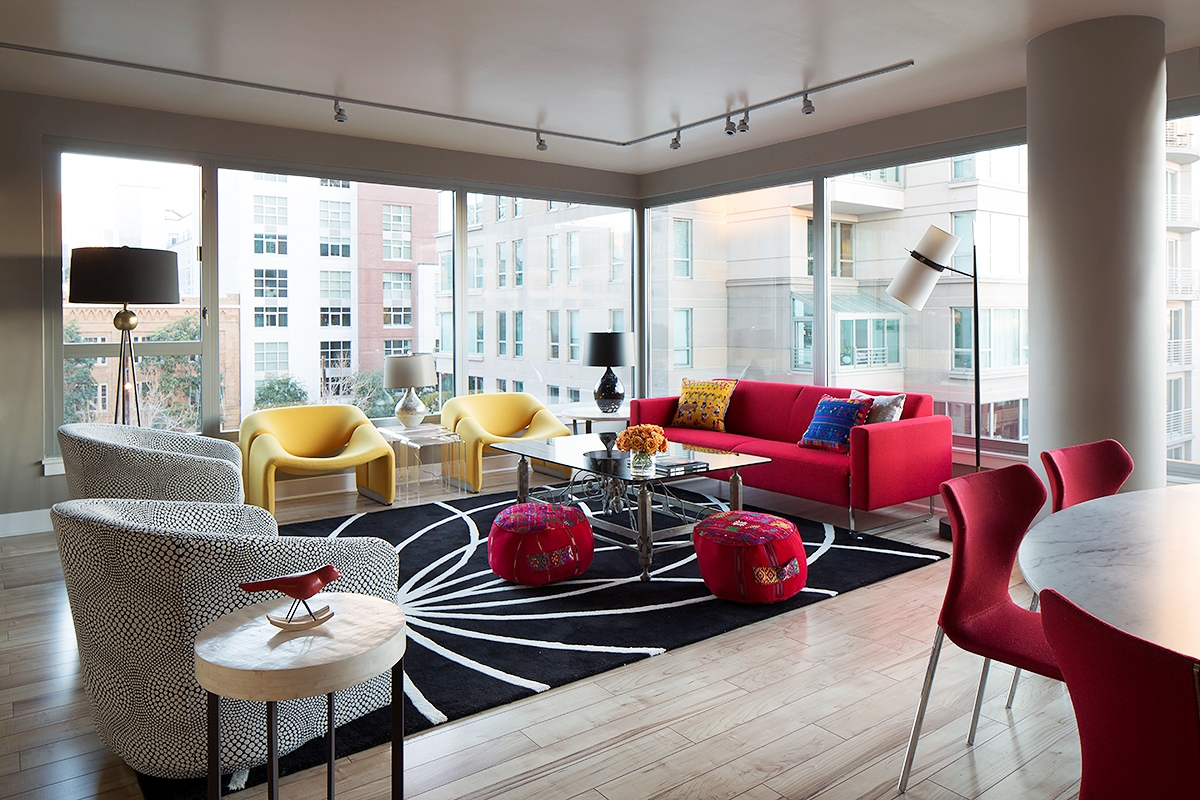
Kimball Starr Interior Design’s First Place winning entry is a Contemporary Guatemalan Living Room, created for a retired couple who spend half their time in a contemporary 2-bedroom condo with views of downtown San Francisco, and the rest of the time in Antigua, Guatemala. Travel is an integral part of the homeowner’s lives, and they wanted to bring back the rich woven textiles and vibrant colors of their Central American journeys to their stateside home.
Kimball Starr Interior Design 1st place award winning living room for Best Contemporary Room / photo by Eric Rorer
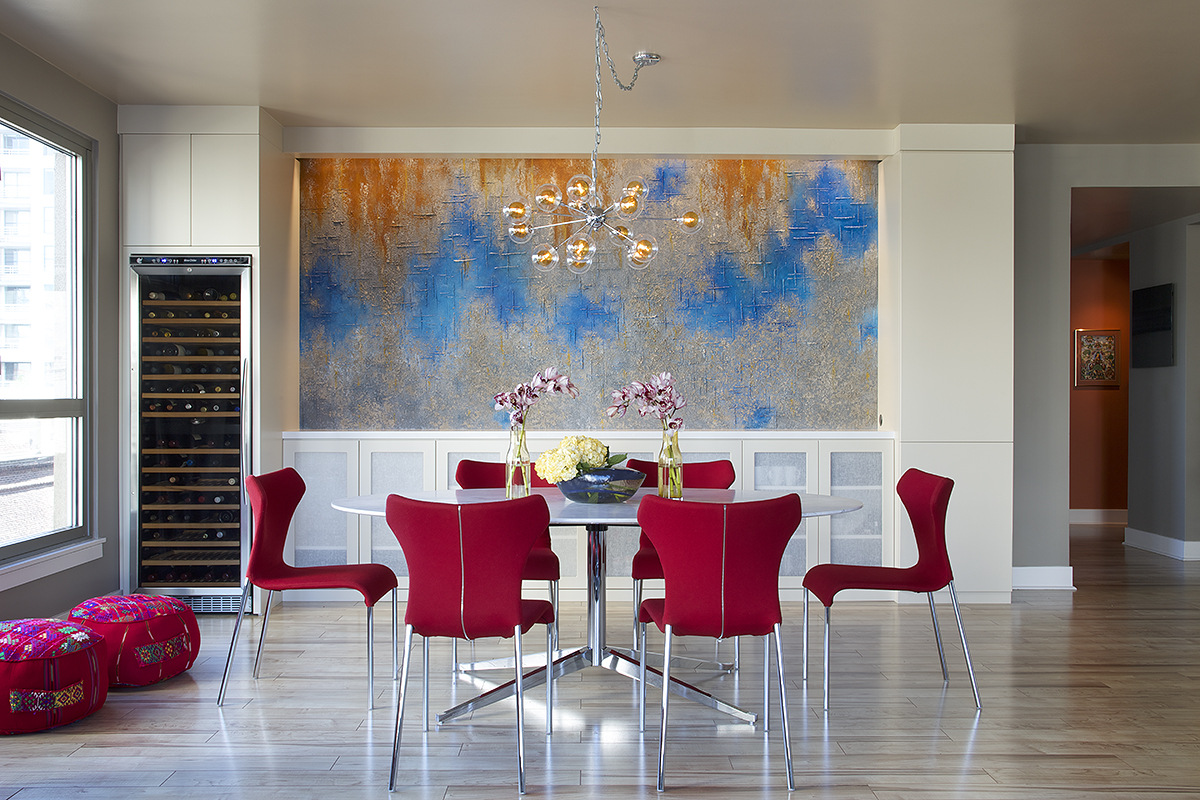
To reflect this cultural reference in the living room, a table base used in a Guatemalan wedding precession supports a custom-cut glass top to create the couple’s coffee table. The adjacent dining room highlights an art piece created from textured paint on plaster, inspired by the weathering, layering and patina of a building’s exterior in the Central American climate. Colors and fabrics used throughout the space were thoughtfully selected to remind the couple of their Guatemalan experiences.
Contemporary Dining Room by Kimball Starr Interior Design / photo by Eric Rorer
The theme of cultural and personal identity developed through foreign travel is also celebrated in Kimball Starr Interior Design’s Second Place winning entry for “Residential: Modest Budget, Big Impact”, the Moroccan Mid-Century Loft. Combining elements in this San Francisco loft from Morocco, mid-century modern design, and a little Asian inspiration all reflect the homeowner’s globe spanning residences of Hawaii, France, and the San Francisco Bay Area, along with his exotic travels on African safari when he’s not rocking the Kasbah!
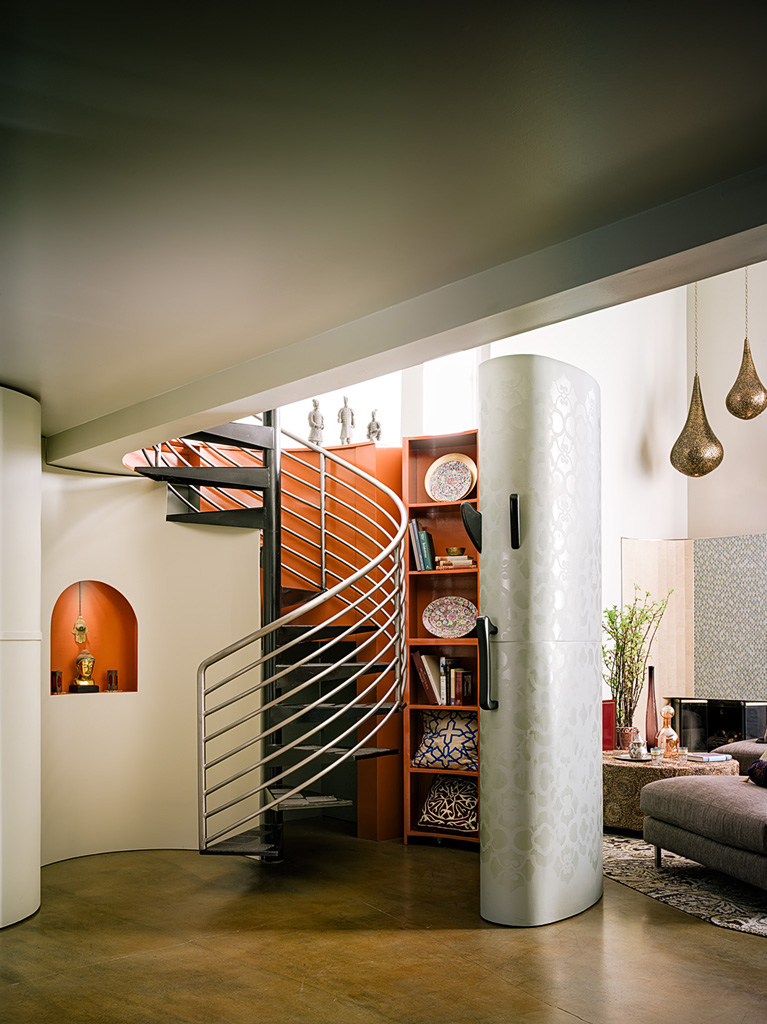
2nd Place Winner for Residential: Modest Budget, Big Impact by Kimball Starr Interior Design / photo by Joe Fletcher
Moroccan features are reflected in the pattern and texture of fabrics such as the area rug in the living room, stenciling pattern on the rolling bookcase surrounding the spiral staircase, and the hand-tooled oversize teardrop brass pendants. The slipper chairs, sofa, and dining room table are all mid-century modern design, while the alabaster china hutch and Buddha sitting in the colorful stairway alcove bring in Asian elements.
The modest budget constraint of keeping under $50,000 was achieved by mixing vintage finds such as the red lacquer media cabinet and the dining table set, with high-end items such as the automated draperies, custom upholstered pieces, and rug custom-shaped for the space. See more information about this project in the Loft Design series of blogs!
2nd Place Winner for Residential: Modest Budget, Big Impact by Kimball Starr Interior Design / photo by Joe Fletcher
Starr says “It was exciting to work with the homeowners and bring what they love about their life and travels into their homes. Not only was I able to make their interior spaces function better for their individual lifestyles, I was also able to give them beautiful homes they loved and reminded them of their happiest moments and experiences in their lives.”
The judges of the 2014 Design Excellence Awards agree. One judge’s comment on the Contemporary Guatemalan Living Room was “Fabulous result and spot-on regarding meeting [the] client’s purposes and goals. Creative, appropriate and artfully done!”
Kimball Starr at the Design Excellence Awards at NIDO living showroom, Sept 18, 2014. Photo by TiagoRussoPhotos.com
Kimball Starr Interior Design, Allied ASID, is a San Francisco award winning interior design firm whose interior design has been featured on national television and globally published in a series of hardcover books. Interiors spanning contemporary design to traditional interiors show the variety of style expertise provided by this San Francisco Bay Area designer.
Here’s the second part of the television segment featuring Kimball Starr sharing tips on how to make the most of your small home interiors. If you missed the first half, here’s Design Tips for Small Space Living: Video 1 of 2.
Video transcript below:
♪[music]♪
– [Announcer] With your host Sheryl Borden.
– [Kimball] And this is a small dining area where I’ve used a bench instead of dining chairs because it’s open to the living area and it was very tight to get by, so a bench will only take up at about 15 inches whereas a dining chair can take up 18 to 24.
– [Sheryl] Oh that’s a good tip.
– And it definitely saves space.
– Yes but I just thought it was, you know, a choice, but I didn’t realize it also had a purpose…
– Yeah.
– …like this. Good idea.
– Yeah, very compact. And this, of course, we have our reflective surfaces, which reflects the view and helps the space feel bigger.
– Bigger.
– This is for, if you don’t have a lot of space for home office, this is in the living area.
– And again, you’re using the walls.
– That’s right.
– As a furniture piece.
– And this could be with, normally could just be an empty wasted space because the TV area is over here and the bay window, but by putting some floating shelves, streamlined furniture is really important, small in scale, thin, not a lot of ornamentation, and then by having reflective surfaces, the chrome on the base of the chair and then the reflective surfaces on the shelves, it helps reflect light and makes it feel like it’s more spacious. And for your living areas, we have, this is a very tight space. This is actually, might seem counterintuitive to some people. We took the sectional and went the whole width of the room. So it fits completely wall-to-wall, because there’s a piece of glass over here on this side that you can’t go any further. But because we kept the wall color and the sofa the same, it just blends and floats. And then here we have a coffee table that’s double duty where it has storage but it can also be used as additional seating if you’re having a party.
– That’s a good tip.
– For storage in the kitchen, the island is great, it’s kitchen storage. It also has a slide-out counter over here so people can sit and have drinks. And then we also have over here, here’s a little pointer, a built-in storage for the media and office so these Shoji screen doors slide to the right side and there’s a slab…
– Close it part of the time.
– That’s right. So you can close it completely. And this was just an unused closet space. This is how you can take hidden niches and really utilize it into functional spaces.
– Right. And it’s very attractive too.
– And this has multiple functions here. So this space, they didn’t have a dedicated dining area. This is the entry area, so this place is only 650 square feet.
– Total.
– It’s a one bedroom, total.
– Okay.
– Very small.
– So the only place to sit and have a meal was the island that you just saw, or here.
– So this becomes a coffee table, but it’s also a dining table.
– That’s right, with the adjustable-height coffee table, it can adjust and the built-in banquette utilizes all your space. The seats of the banquette actually come off and you can have storage underneath.
– Storage. I love storage.
– So it keeps everything nice, put away, but it maximizes your storage. And for bedrooms, if you don’t… This is a very tight space. Wall mounting your bedside lamps helps keep your nightstands free. And if you’re in a closet for your bedrooms, this was a very small space that had bi-folds that would open up into the space so if you replace it with a curtain, it adds softness.
– Decorative. And it’s soft.
– So this is great also if you have a lot of doors in the hallway. A lot of closets and doors going on and they are always in the way, just to replace them with soft textiles. And utilizing storage around stairways.
– Oh yeah.
– So this is a spiral staircase and it’s been clad with a bookcase that’s mounted on a piano hinge so it’s a huge bookcase…
– It looks like it.
– … that you pull open. So it is, not only does it serve a great storage function, it’s decorative by putting a real bright pop of color on the inside, it looks really interesting from the outside.
– What a conversation piece!
– Yes it’s definitely a conversation piece. And then for people who are in lofts which are not necessarily small spaces but they don’t have anywhere for storage. They’re usually just a bedroom and big open space and nothing’s partitioned off. So I created this room within a loft and this is glass sliding doors so that when we have overnight guests they can stay in there, and when the doors are open, it looks like this.
– Oh how nice! That’s the same room?
– That’s the same room, so the doors slide open and then back here is a murphy bed. Just drops down and your overnight guests can stay there.
– Great ideas. You’ve really dealt with lots of interesting challenges.
– San Francisco has a lot of small spaces, yes.
– Well, thank you so much. I have really enjoyed seeing these examples.
– All right, great. Thanks so much, Sheryl.
Kimball Starr is a San Francisco award winning interior design firm whose interior design has been featured on national television and globally published in a series of hardcover books. Diverse spaces spanning contemporary design to traditional interiors are indicative of the variety of styles provided by this San Francisco Bay Area design firm.